cases >> Gateway Bio
‘TROJAN HORSE’ TO DELIVER ANTIBIOTICS INTO THE BACTERIAL CELL
‘TROJAN HORSE’ TO DELIVER ANTIBIOTICS INTO THE BACTERIAL CELL
Antibiotic resistance is one of the world’s biggest health problems. Due to the overuse of antibiotics, bacteria have adapted, causing medicines to work less and less effectively. Nearly 5 million people die annually as an indirect consequence of this. University of Twente spin-off Gateway Bio appears to have found the solution to this problem. UT researcher Jos Paulusse developed a method to deliver antibiotics directly into the cell, like a kind of Trojan horse. Co-founder Mark ter Heide explains how their solution could lead to a revolution in healthcare.
The World Health Organization (WHO) warned in a 2025 report about the dangers of increasing antibiotic resistance. Between 2018 and 2023, antibiotic resistance rose by more than 40%, making bacteria like E. coli more dangerous. “For a long time, there have been few regulations regarding the use of antibiotics, and for large pharmaceutical companies, it generates significant revenue,” Mark explains. “Now that more legislation is being introduced, producers are investing less in new antibiotics because there is less market for them. Meanwhile, resistance persists among patients.”
Antibiotic delivery vehicle
Existing antibiotics, therefore, need to work better. That is why Gateway Bio is developing an antibiotic ‘delivery vehicle’, a kind of Trojan horse that can deliver antibiotics into the cell, allowing them to bypass resistance mechanisms. Researcher Jos Paulusse has been working for 15 years on the nanoparticle that makes this possible. Thanks to a collaboration with microbiologist Sandra Michel, the team made the unique discovery three years ago that these nanoparticles are also absorbed by bacterial cells. Mark: “We attach a type of food to the nanoparticle. That food is actively absorbed by the bacterial cell, and with it, the antibiotics. We are the only ones so far who have shown that this is possible. This gives us a unique position to bring this to market.”
Market exploration
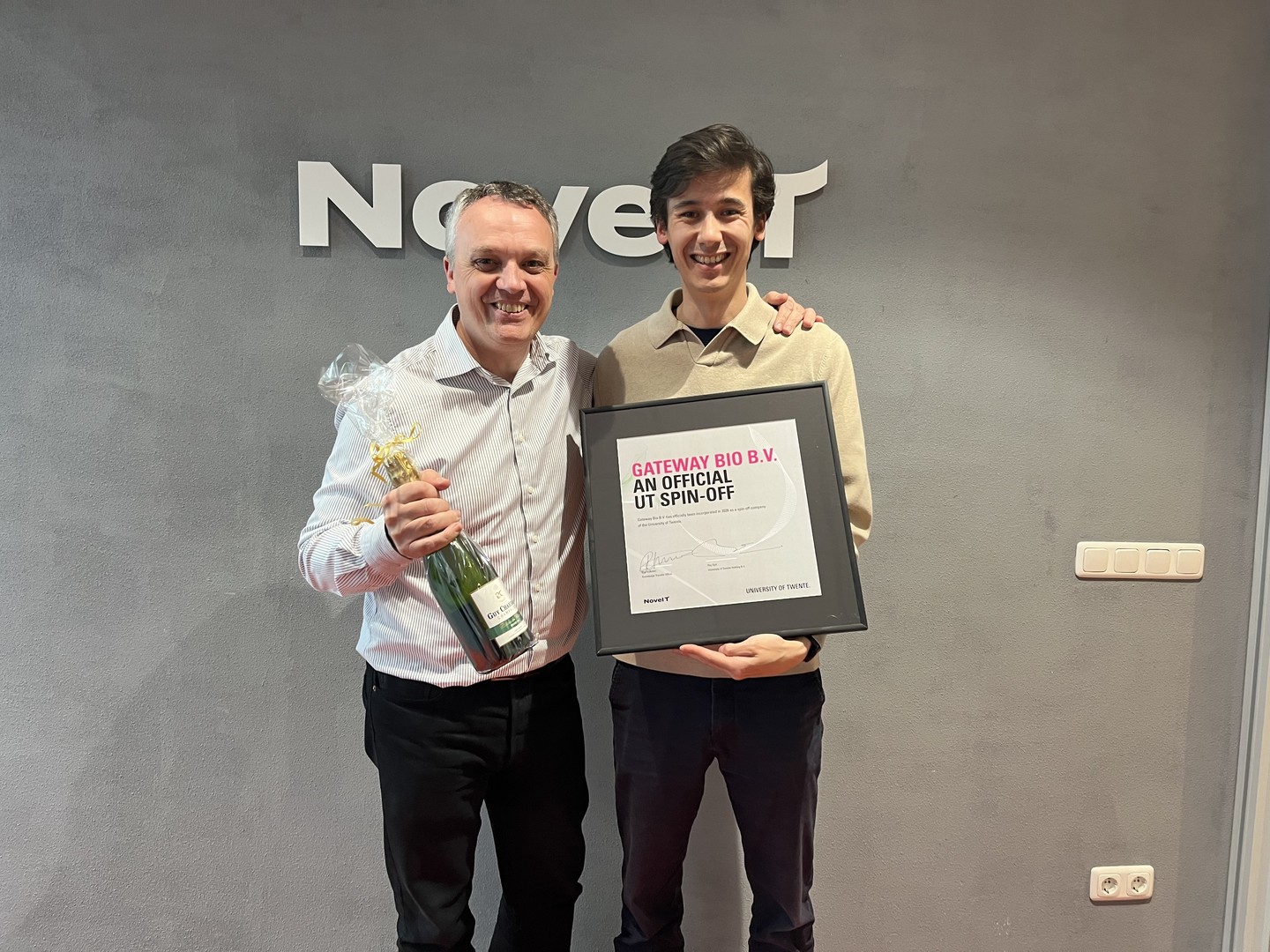
Mark became involved with Gateway Bio during an Ideation Lab from TU Delft’s Impact Studio. Mark: “It was my task to explore who the potential first customers were based on Jos’s research. Even though I knew little about the technology, I simply entered into discussions with people who knew more about it. You don’t need to understand the entire technology, but above all, you need to understand whether it can solve the customer’s problems. That was an incredibly enjoyable collaboration, which is why we decided to continue together. I am now involved full-time, and in mid-May 2026, we established Gateway Bio as an official spin-off from the UT.”
Building for the beginning
Even before the founding, the team was already building: they participated in the START Program, were part of Biotech Booster, and won the Gulliver Startup Competition and the Rough Diamond Award at the Philips Innovation Award. They want to continue that success. “If we can save at least 1 million patients, that would be a great milestone,” says Mark. And for the team, that is just the beginning. In fact, it creates a new way of administering antibiotics. The World Bank estimates that antibiotic resistance could lead to $1 trillion in extra healthcare costs by 2050. Because if the antibiotics do not work, patients continue to receive more care, they build up even more resistance, and they occupy a hospital bed longer. And the longer patients stay in the hospital, the less they are able to work. And most importantly: too many people are still dying. We want to give everyone access to antibiotics that work."

"We want to give everyone access to antibiotics that work."
Mark ter Heide
co-founder Gateway BioMore about
Gateway Bio
Gateway Bio is a spin-off of the University of Twente, founded in May 2026 by researcher Jos Paulusse and co-founder Mark ter Heide. Building on fifteen years of research, the company is developing a 'delivery vehicle' that delivers antibiotics directly into bacterial cells like a Trojan horse, thereby bypassing resistance mechanisms. With this, the company aims to offer a solution to the global antibiotic resistance crisis.