cases >> XCTE
ACCELERATED FATIGUE TESTING FOR COMPOSITES
ACCELERATED FATIGUE TESTING FOR COMPOSITES
We prefer to have innovations on the market yesterday rather than today. But when it comes to new materials, a lot of time is lost testing to ensure they do not break or wear out too quickly under high pressure. Can't that be done faster? Friso Oude Tanke wondered after his graduation thesis. Meanwhile, Dr. Dario Di Maio had already been researching this subject for 15 years. During a consortium project, Friso collaborated with Dario, and they discovered a way to do it faster – and more accurately. Because this idea was interesting to the market, Friso and Dario joined forces with Jip van Tiggelen, resulting in the UT spin-off XCTE.
Although digital innovations are shooting up like mushrooms, physical innovations are not reaching the market any faster than before. This is mainly due to the qualification process, preceded by the testing phase, during which the rate at which fatigue occurs is measured. In other words, how quickly the material no longer becomes strong enough for its intended purpose. Friso: “Think of the material for an airplane wing. It is regularly subjected to heavy pressure and must not wear out too quickly. Even a micro-crack is enough to cause unsafe situations.” Currently, such composites are tested in machines with hydraulic pumps that repeatedly apply pressure to the material. “Suppose you have to make an iteration on a long-term test,” Friso explains. “You’re easily half a year down the line before you can make a final decision on the composition of your composite. We can reduce that to a few days.”
High-frequency vibrations
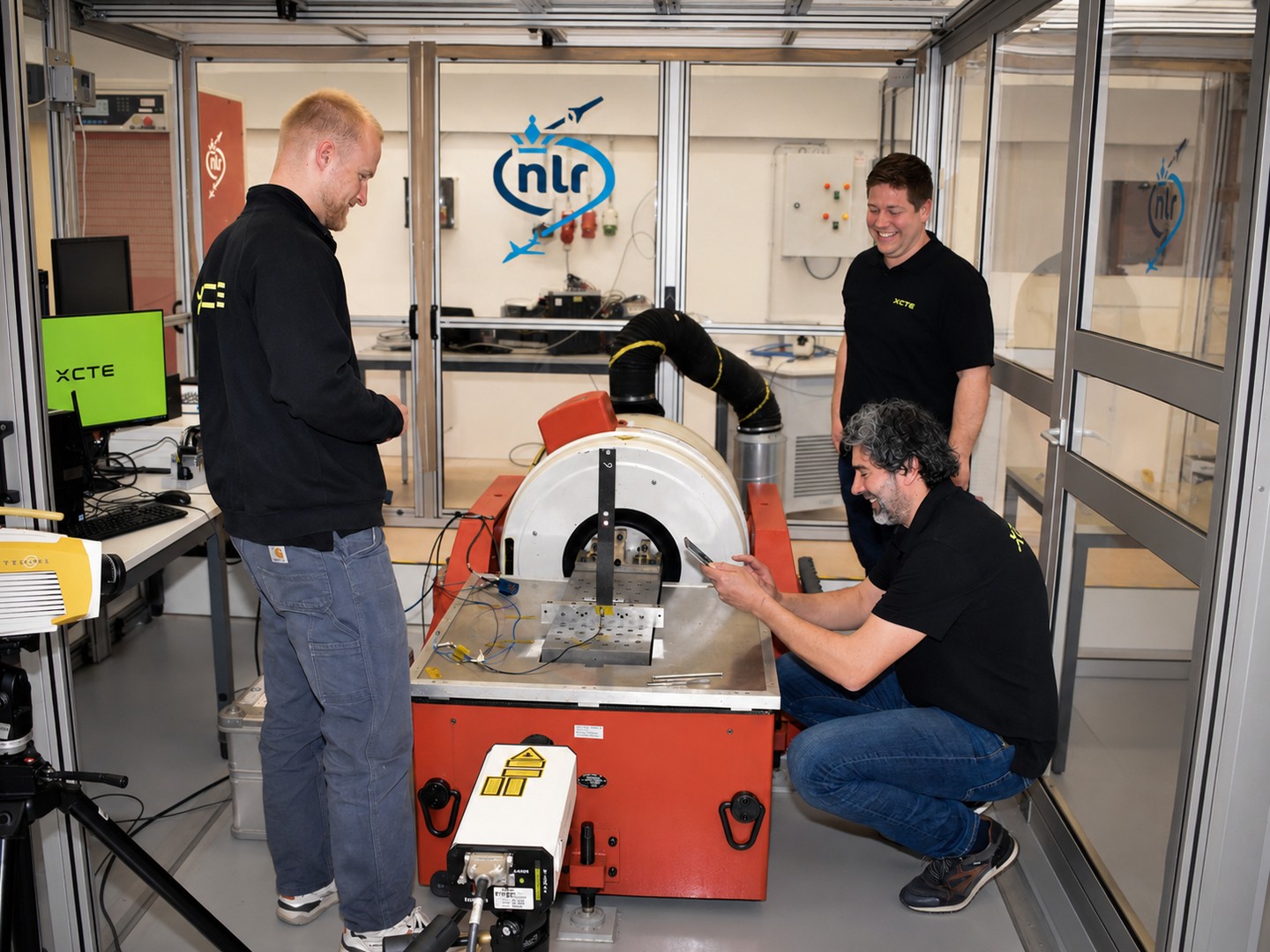
They achieve this through their innovative method, based on a breakthrough achieved after years of research by Dario. “For my thesis, I experienced how time-consuming the traditional method of testing is,” says Friso. “With XCTE, we use high-frequency vibrations instead of applying pressure with hydraulic pumps.” He demonstrates how it works. Behind a soundproof door stands the test setup: a kind of subwoofer with a clamp on top, resembling a vise. A small carbon plate is clamped inside it, onto which a laser shines. “We make that piece of carbon vibrate at a high frequency, causing it to eventually ‘flutter,’ or resonate. Think, for example, of a bridge that vibrates enormously due to strong winds and subsequently starts to sway. We do that on a small scale. So we work with the laws of nature. With the laser, we then measure whether the stiffness of the material changes and whether cracks appear. We can do this at the micro level, which makes our tests not only faster but also more accurate.”
Exploring markets
Faster and more accurate is exactly what the market is clamoring for. “Many parties are working on developing new materials, for example, for aerospace, the automotive industry, and defense. Currently, the time-to-market is far too long for innovations within these sectors. Imagine you have developed a new material that is super strong and cannot be detected by radar. It could easily take ten years before it reaches the market. While actually, you want to have those materials right now.” With the support of business developer Emiel Pegge, the XCTE team was able to explore various markets. They are starting in the material supplier sector, intending to subsequently expand into the automotive industry. Friso: “We benefited greatly from that support, including the support from the KTO during the founding of the spin-off. Entrepreneurship has always appealed to me, so it is nice to have that support while building our spin-off."
High ambition
Currently, the team is working on setting up pilots. From there, the team aims to grow towards the standard for material testing. “So people will think: ‘for quick tests, XCTE is the place to be.’ That is the long-term goal,” says Friso about the future. “We also see opportunities to create a database using all the collected data from various materials. With AI, we can then make predictions about specific materials and their performance. We still have quite a few steps to take before we get there, but there is certainly potential. Moreover, in addition to composites, we could eventually test the performance of adhesive or welded joints.” For now, the team is looking for industrial partners with whom they can run pilots or start research collaborations. “We have a lot of ambition, and there is demand from the market. So now is the time to further develop our prototype.”
More about
XCTE
XCTE is a spin-off of the University of Twente and is at the forefront of rapid composite fatigue testing and modelling. By exciting materials at high frequencies, they significantly reduce testing time, enabling quicker and more accurate durability assessments. Their solution offers the best possible outcomes for full-scale testing and validation, helping companies optimize their composite structures for both performance and cost.