cases >> Temporal Photonics
PORTABLE OPTICAL ATOMIC CLOCKS WITH PHOTONIC ACCURACY
PORTABLE OPTICAL ATOMIC CLOCKS WITH PHOTONIC ACCURACY
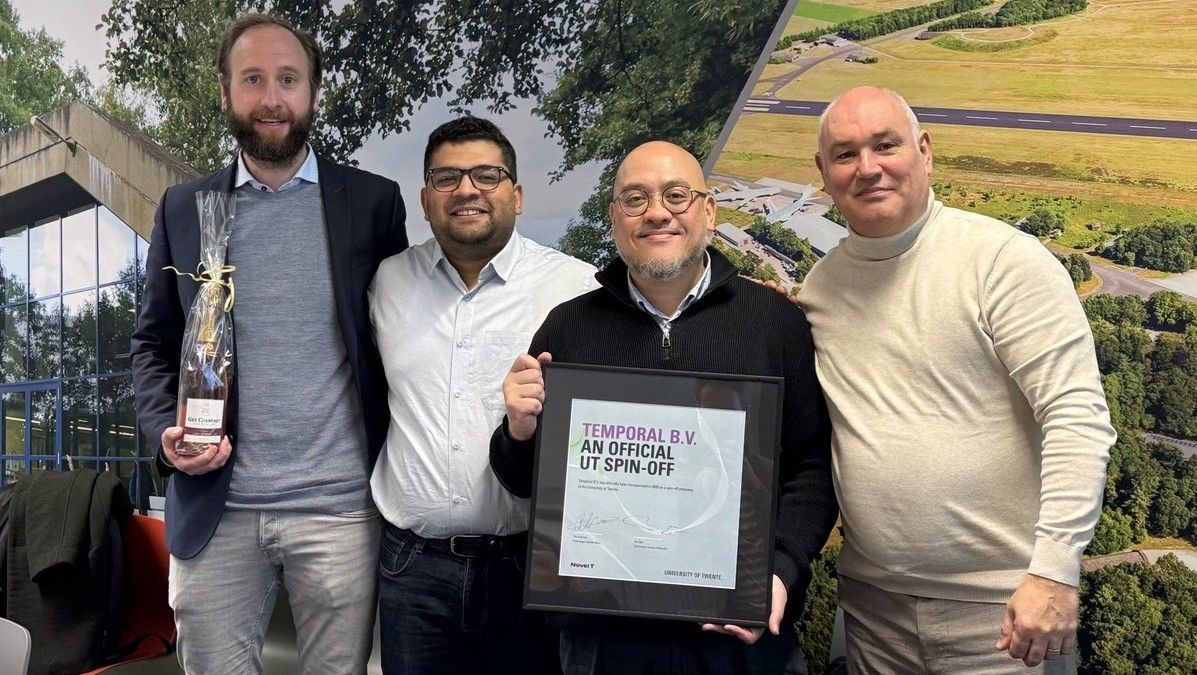
Clocks are all around us. Not just on our wrists or on our phones, but you also need to be able to tell time to measure speed or distance. Atomic clocks provide the accuracy and stability necessary for that. However, current atomic clocks are as big as a fridge or can even fill an entire room. Researchers from the Nonlinear Nanophotonics (NLNP) group of the University of Twente wondered whether they could make a small optical atomic clock based on integrated photonics. Akhileshwar Mishra took on the challenge, together with co-founders Edwin de Steenhuijsen-Piters, David Marpaung and Lennart de Vreede. The result: UT spin-off Temporal Photonics.
If you live in Twente, you’re probably familiar with the ‘Twents kwartiertje’: the 15 minutes you’re allowed to run late. Yet, for the team of Temporal Photonics, time is of the essence. So why do we need to be able to tell time with the precision of atomic clocks? Akhileshwar: “Without atomic clocks, our modern world would not be the same. It’s not something mundane that you can take for granted. The fact that the clock on your cell phone updates automatically based on which time zone you’re in is only possible because it determines your location with GPS and sends over the correct time through the signal of the nearest cell phone tower. And the time it’s showing comes from an atomic clock. An atomic clock doesn’t just measure time; it also measures distance and speed and aligns all systems. It makes sure everything in the world runs on time.”
Network resilience
While being so essential to our daily lives, atomic clocks are currently large and bulky. Those are sent off on GPS satellites, so we can use smaller receivers in airplanes or drones. Many systems depend on GPS, while the signals are weak and can be disrupted easily. What if we could have an optical atomic clock the size of a lunchbox, so we can take it with us wherever we go? “We could shoot smaller satellites into space, causing less space debris,” Edwin explains. “Deep space exploration will therefore also become easier – because you also need accurate timing for that.”
Still, the team wants to deploy their clocks closer to home. Edwin: “Since it’s smaller, it’s also more energy efficient. If you build it into a vehicle, you don’t need an extra power source. And with a small battery, soldiers could put it in their backpacks and move around in remote or hostile areas with it for weeks before the battery runs out. All these clocks together can form a mesh network in which they keep each other in check. Therefore, you don’t have to rely on GPS anymore, making networks extremely resilient.”
A different approach
The reason why Temporal Photonics is able to reduce the size of atomic clocks drastically is because of a different approach. “Atomic clocks are made by people who are specialized in atomic and molecular physics,” Akhileshwar paints the picture. “The NLNP group of the UT is world-leading in integrated optics. So instead of optimizing the atomic clocks by focusing on atomic molecular physics, we approach it from the side of integrated optics by optimizing the subcomponents.” Edwin: “Chip-sized atomic clocks have been around for some time, but the smaller they get, the less accurate they become. Ours will be as stable as the hydrogen maser clock, which is currently the gold standard for short-term frequency stability. The major difference is that ours won’t be as big as a fridge.”
Can-do mindset
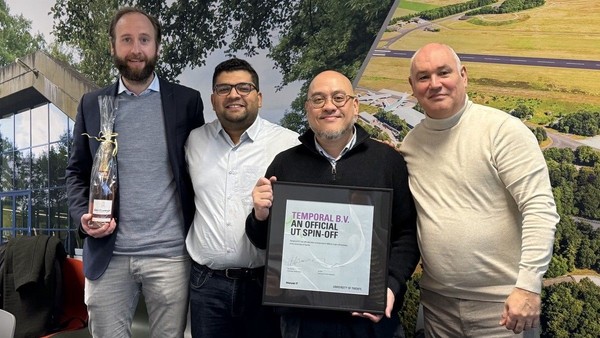
Getting to this point didn’t go without challenges. Early 2025, David and Akhileshwar submitted a proposal for optical atomic clock development to a competition. The response they received was that the proposal looked nice, but that the team didn’t have experience in building the clocks. Akhileshwar: “To us, that was the spark we needed to prove to them we could build it. The team saw the potential and called Lennart and Edwin to join the team to strengthen the commercial and organizational side.” With the support of Novel-T, they founded their spin-off in February of 2026.
Sustainable impact
Time to start working on their dream. Edwin: “If all goes well, we’ll have the MVP end of 2027. Of course, it all depends on funding, but eventually we’d be able to order our chips at New Origin and produce clocks, because the goal is to have a Temporal clock in every car.” Akhileshwar adds: “Once we manage that, we’ll be able to create sustainable impact for a resilient future.”
"Without atomic clocks, our modern world would not be the same."
Akhileshwar Mishra
co-founder Temporal PhotonicsMore about
Temporal Photonics
Temporal Photonics is a spin-off of the University of Twente and offers a compact, highly accurate, and robust atomic clock designed for long holdover time in a handheld system. Built on years of experience in semiconductor processing and integrated photonics, the technology of Akhileshwar Mishra, Edwin de Steenhuijsen-Piters, David Marpaung and Lennart de Vreede delivers reliable timing without the need for a daily GPS or GNSS signal.